
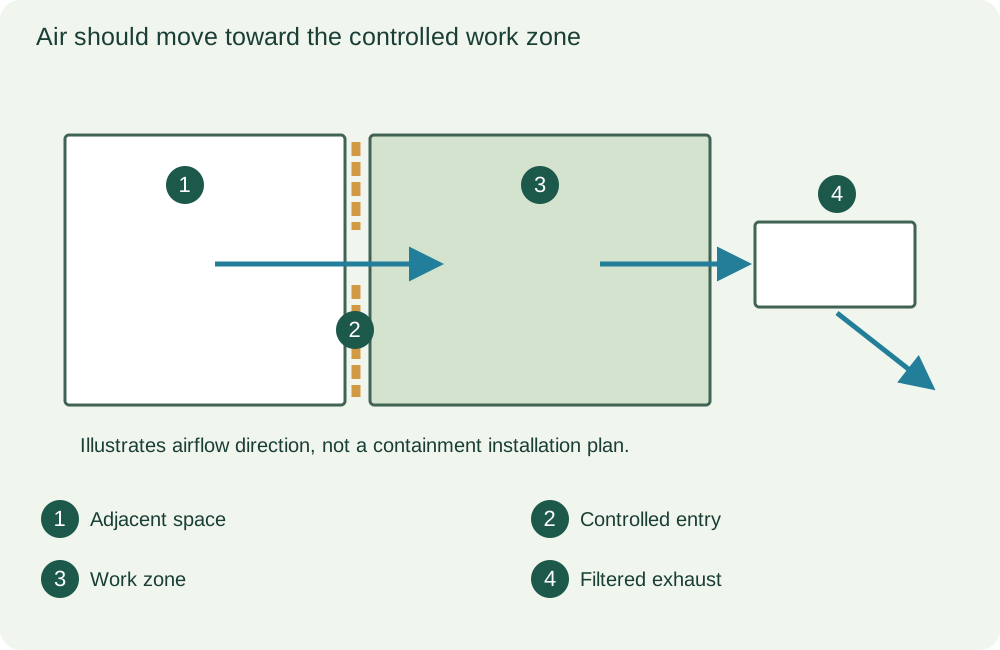
- Adjacent space
- Controlled entry
- Work zone
- Filtered exhaust
What does mold containment do?
Containment limits the transfer of disturbed material and airborne particles from the work zone into adjacent areas.
Removing drywall or handling affected insulation can release dust and particles. Barriers define the work area, while the entry and debris route affect how material moves through the home. Openings and HVAC pathways can connect otherwise separated spaces.
Containment is a work control. It does not remove the moisture source or replace cleaning of affected surfaces.
What is the difference between limited and full containment?
EPA describes limited containment for many areas of 10-100 square feet and full containment for larger areas or situations with greater potential for spread.
These are guidance categories, not automatic price brackets or universal rules for every house. The nature of the material, the intensity of growth, disturbance and the people nearby also matter. Professional judgment can call for stronger controls in a smaller area.
Limited containment generally uses a single barrier layer. Full containment uses a more substantial separation and an entry/decontamination area. The table below explains their roles without presenting a homeowner construction specification.
Which control addresses which part of the work?
Barriers, filtration, surface cleaning and drying are complementary functions, not interchangeable services.
| Control or tool | Primary function | What it does not prove |
|---|---|---|
| Limited containment | Separate an appropriate smaller work zone. | That area alone determines the necessary control. |
| Full containment | Provide stronger separation and controlled entry/exit. | That every project needs the same layout. |
| HEPA vacuum | Remove particles from accessible surfaces. | That the moisture source is corrected. |
| Air scrubber | Filter the air passing through it. | That negative pressure is established. |
| Dehumidifier | Reduce airborne water vapor. | That affected material has been cleaned. |
How does negative pressure control airflow?
Negative pressure draws air toward the contained work area instead of allowing contaminated air to flow outward into adjacent space.
The barrier and the air-moving arrangement work together. A recirculating air scrubber can filter room air without necessarily establishing that directional pressure difference. Equipment placement alone therefore does not prove containment is effective.
The diagram shows the intended direction conceptually. It is not a design for sizing fans or choosing an exhaust route; those depend on the building and work conditions.
How do HEPA vacuums, air scrubbers and dehumidifiers differ?
A vacuum treats surfaces, an air scrubber treats air passing through its filter, and a dehumidifier removes moisture from air.
HEPA refers to filtration performance, not the full quality of a cleanup. Surface cleaning is still needed where particles remain on building materials. Drying equipment does not remove existing growth from drywall or insulation.
The HVAC guide also explains why room filtration cannot repair a wet duct liner or blocked condensate drain.
What happens to debris and protective equipment?
They are handled through the planned work route to limit carrying contamination into clean areas.
Access and waste movement are part of containment rather than an afterthought. Debris from invasive work is different from normal household cleaning waste. The appropriate controls depend on the material, extent and work method.
An attic hatch opening into a hallway and a basement with separate exterior access create different movement paths. The plan needs to reflect the actual building.
Why is final cleaning a separate stage?
Removal of affected material can leave dust and debris on retained surfaces, so the work area still needs final cleaning and evaluation.
The absence of the original drywall does not mean the remaining framing, barriers and nearby work surfaces are clean. Final cleaning addresses that remaining material before controls are removed as appropriate and finishes are restored.
The remediation process connects cleaning with moisture correction and completion review. A sampling result, where used, must be interpreted in that context.
Explanatory example
Why is an air scrubber alone insufficient?
It filters air but does not define the work boundary. In this example, affected drywall is removed beside an open doorway while a machine recirculates air in the room. The machine does not itself prevent movement through that doorway or clean dust on retained surfaces. Effective control also needs the appropriate separation, movement route and final cleaning. This illustrates the functions, not a specification for a DIY containment setup.
Common questions
Is an air scrubber a dehumidifier?
No. Air scrubbers filter particles. Dehumidifiers remove water vapor. A project can need one or both, depending on the work and moisture conditions.
Does plastic sheeting alone create negative pressure?
No. Sheeting creates a physical boundary. The pressure relationship depends on airflow and the complete arrangement, including openings and exhaust.
Is clearance always an air test?
No. A completion review can include observations, material conditions and the agreed work record. Sampling may form part of it when appropriate, but the word clearance does not establish a universal test or health guarantee.
Sources and editorial approach
Gettysburg Mold Guide explains published building and cleanup guidance. This page was updated September 21, 2026. It is general information, not a property inspection or a medical assessment. The example explains a building condition; it is not a customer case study.