
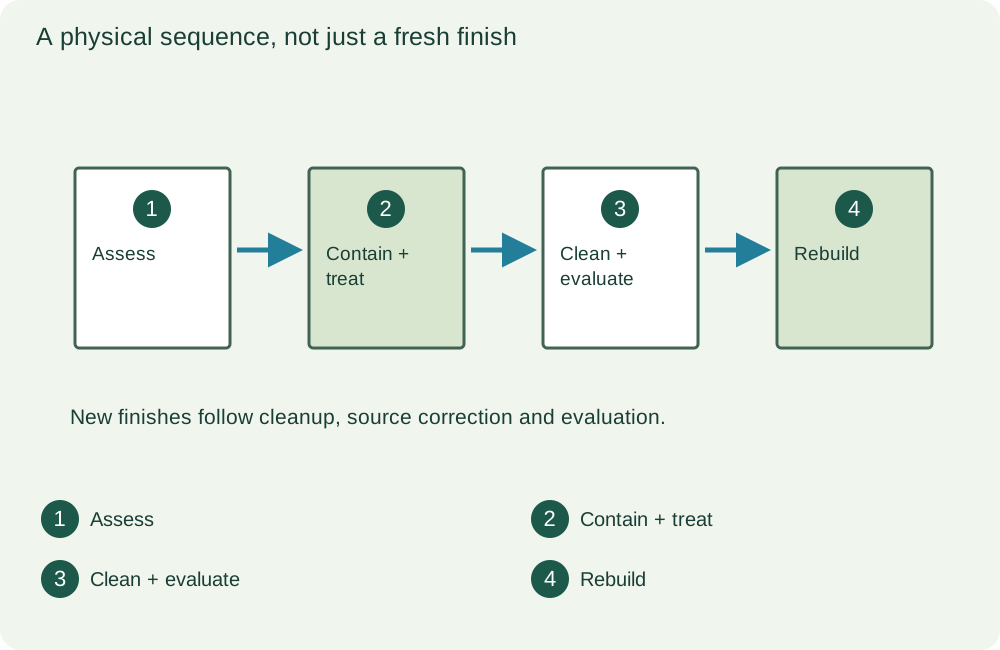
- Assess
- Contain + treat
- Clean + evaluate
- Rebuild
How is remediation different from removal and restoration?
Removal addresses growth or affected material; remediation includes the wider investigation and controls; restoration repairs the damaged building.
For example, removing affected drywall is a material task. Protecting adjacent rooms, treating exposed surfaces and evaluating moisture are part of the broader response. Installing new board, trim and paint is restoration.
These stages can be provided by one company or several trades. The terms describe work, not a guarantee that every service is included in one project.
What happens during mold remediation?
The sequence is assessment, appropriate work-area controls, material cleaning or removal, final cleaning and evaluation before rebuilding.
- Assess: locate the growth, affected materials and moisture conditions.
- Control: separate work that could spread contamination from unaffected areas.
- Treat: clean salvageable surfaces and remove material that cannot be adequately cleaned.
- Finish cleaning: address remaining dust and debris in the work area.
- Evaluate: review the treated area and moisture correction before returning it to normal use or rebuilding.
The sequence adapts to the property. A small exposed surface and an affected insulated wall do not need identical access or removal.
What does remediation include, and what is a separate service?
Cleanup, moisture repairs and reconstruction are related but distinct parts of recovery.
| Part of the work | What it does | What may remain separate |
|---|---|---|
| Investigation | Identifies affected materials and moisture conditions. | Additional access or laboratory work. |
| Containment and filtration | Limits spread during disturbance. | Repair of the underlying water source. |
| Cleaning and removal | Treats or removes affected material. | Replacement finishes and structural repairs. |
| Completion review | Evaluates the agreed work and conditions. | A separate assessor where arranged. |
| Restoration | Rebuilds damaged finishes or components. | Optional remodeling upgrades. |
Which materials are cleaned and which are removed?
The decision depends on cleanability, access and condition, rather than mold color alone.
Hard accessible surfaces are different from absorbent finishes with growth inside them. A damaged porous layer may need removal to expose and assess the assembly behind it. Structural deterioration is a separate repair issue.
The basement material comparison shows how masonry, drywall, wood and carpet lead to different work. A photograph of the finished face cannot answer every concealed-material question.
How much does mold remediation cost?
Angi reports a U.S. average of about $2,400 per project, with a typical range of roughly $1,200-$3,800.
These rounded national figures are budgeting context, not a measured Gettysburg average or a quote. The source reports an average of $2,368. Affected area, access, material removal and rebuilding can change the total. Source: Angi’s mold remediation cost guide, checked September 21, 2026.
A room’s floor area is not necessarily the affected surface area. A small finished wall with concealed damage can involve different work from a larger accessible hard surface. Structural repairs and new finishes can add to the cleanup cost.
How long does mold remediation take?
The mold-removal stage takes about 1-5 days in COIT’s general project timeline; assessment, drying and rebuilding can extend the overall recovery.
COIT’s timeline lists assessment at 1-2 days and drying at 1-3 days, with restoration varying by damage. These are general stage estimates, not a Gettysburg scheduling promise. Some activities overlap, so the figures should not simply be added into a guaranteed finish date.
Access, material removal and drying conditions affect progress. The water damage guide explains why extraction, structural drying and mold cleanup have different endpoints.
How is completed remediation evaluated?
The evaluation considers the treated area, remaining visible growth or debris, moisture correction and any agreed inspection or sampling.
A coat of paint or an air scrubber on site is not proof of completion. Any sampling must have an explained purpose and interpretation; there is no universal federal airborne mold threshold for a house.
Evidence of renewed water entry or growth after work points to conditions that need reassessment. The inspection guide describes how findings and limitations are recorded.
Explanatory example
What does remediation look like behind an affected wall?
In this example, a leaking pipe wets paper-faced drywall and insulation. The source is repaired, affected finishes are assessed and removed where necessary, and the exposed cavity is cleaned and dried. New insulation and board are installed only after those steps are resolved. This connects the physical work to the result: a repaired source and treated assembly, rather than simply a newly painted wall.
Common questions
Can remediation guarantee zero mold spores?
No. Mold spores are part of the environment. The relevant goal is to address indoor growth and the moisture conditions supporting it, not promise a spore-free building.
Can mold come back after professional work?
Yes, if water returns or an affected area remains unresolved. Correcting moisture and evaluating the treated assembly matter as much as the initial cleaning.
Is remediation the same as spraying a chemical?
No. A product application alone does not describe material removal, surface cleaning, work-area controls or source repairs. Those decisions depend on the findings at the property.
Sources and editorial approach
Gettysburg Mold Guide explains published building and cleanup guidance. This page was updated September 21, 2026. It is general information, not a property inspection or a medical assessment. The example explains a building condition; it is not a customer case study.